
Our Blog
Blogs
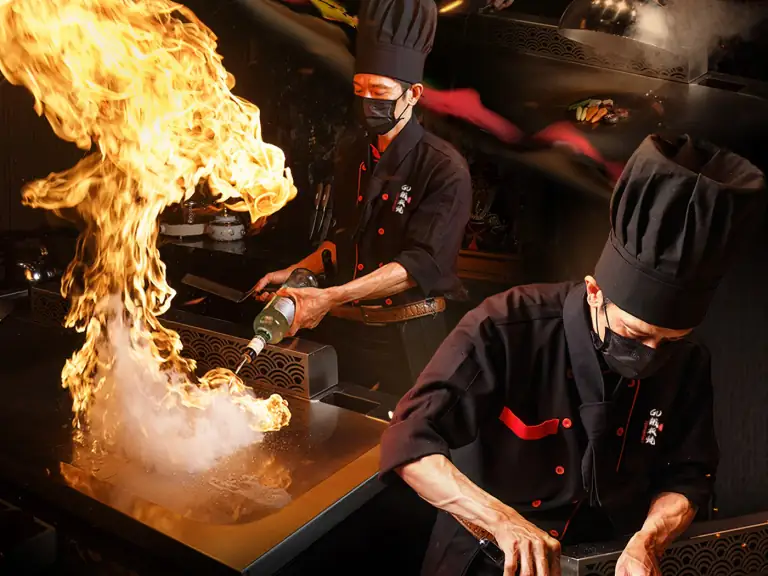
Teppanyaki is a cooking style built around a heated, flat metal surface called a teppan. A chef can sear, grill, warm and finish meat, seafood and vegetables on different areas of the surface, often close to where guests are seated.
The defining feature is controlled cooking on the teppan—not a large flame or performance. Temperature, contact time, texture, doneness and the moment a dish leaves the surface are more important than spectacle alone.
The teppan is a solid cooking surface rather than an open grate. Because metal retains and transfers heat, the chef can work with hotter and cooler zones during the same service.
High heat may be used to develop a seared exterior on meat, while a gentler zone can help manage the interior. Seafood often needs shorter contact to retain moisture and structure. Vegetables and mushrooms require their own timing according to size and water content.
The entire surface is not necessarily used in one way. A chef can move ingredients between areas to control browning, resting, warming and finishing. This flexibility supports different ingredients without forcing them into the same cooking time.
Visible technique is one reason Teppanyaki chefs cook in front of guests. Guests can observe decisions that would usually happen out of sight in a separate kitchen.
Teppanyaki generally uses a solid metal surface and is commonly cooked by a chef. Barbecue and yakiniku often use a grate, flame or heat source beneath the food, and some formats allow guests to cook ingredients themselves.
Service models vary, so guests should still ask who cooks, whether the menu is à la carte or set-based, and what seating is available. A restaurant name or flame video alone does not establish the full format.
Teppanyaki is a cooking method. Omakase is a chef-led way of selecting and arranging a meal. A restaurant may offer à-la-carte Teppanyaki, a fixed Teppanyaki set or Teppanyaki Omakase.
When combined, Teppanyaki Omakase uses the teppan as the cooking method while the courses follow a confirmed sequence. Read what Omakase means for the distinction.
Counter seating reduces the distance between cooking and service. Guests can see heat control, hear ingredients meet the metal surface and receive a dish soon after it is completed.
The counter can also be shared by separate parties. Guests who require privacy should confirm a room rather than assume a counter booking is exclusive. The guide to The Gu’s Teppanyaki seating and private rooms explains the available formats.
Guests comparing local options can use the seven-point guide to choosing Teppanyaki in Ho Chi Minh City.
Teppanyaki Omakase at The Gu is served at a 9-seat counter and in private rooms for 5 or 12 guests, subject to confirmation. Guests select a set and provide dietary information before the restaurant confirms seating, ingredients and preparation time.
No. Flames may appear during cooking, but the core method is control of the flat metal surface, ingredient-specific timing and accurate service.
No. Teppanyaki generally uses a solid teppan and chef-led cooking, while many barbecue formats use a grate and may be cooked by guests.
In the format described here, a chef cooks on the teppan. Other restaurants may use different service models, so confirm before booking.
No. Teppanyaki can be à la carte, a fixed set or Omakase. The cooking method and menu format are separate decisions.
Counter seating is useful for observing the cooking. A private room may better suit groups that prioritise separation or business conversation. Availability must be confirmed.
Browse The Gu dining guides for related articles. Menu, ingredients, pricing, seating and preparation time remain subject to confirmation.
THE GU
This guide explains the culinary concept through The GU’s current counter service, course planning and seasonal ingredient practices. Day-specific ingredients and availability may change with actual supply and are confirmed during reservation.
The GU has a 9-seat Teppanyaki counter, a private 5-person VIP room and a private Teppanyaki room for up to 12 guests.
Yes. The 5-person VIP room and the private Teppanyaki room for up to 12 guests suit dates, birthdays and business dining, subject to confirmation.
Yes. Set menus are adjusted according to seasonal ingredients and actual supply at the time of service.
Send a request through the official Zalo account or call 0703 888 329. A reservation is complete only after The GU confirms seating, set menu, ingredients and any required deposit.
Yes. Ingredients and course order may be adjusted according to seasonal and actual supply; current details are confirmed during reservation.
Information is based on The GU’s current seating configuration and reservation process.